Texoprint Paper
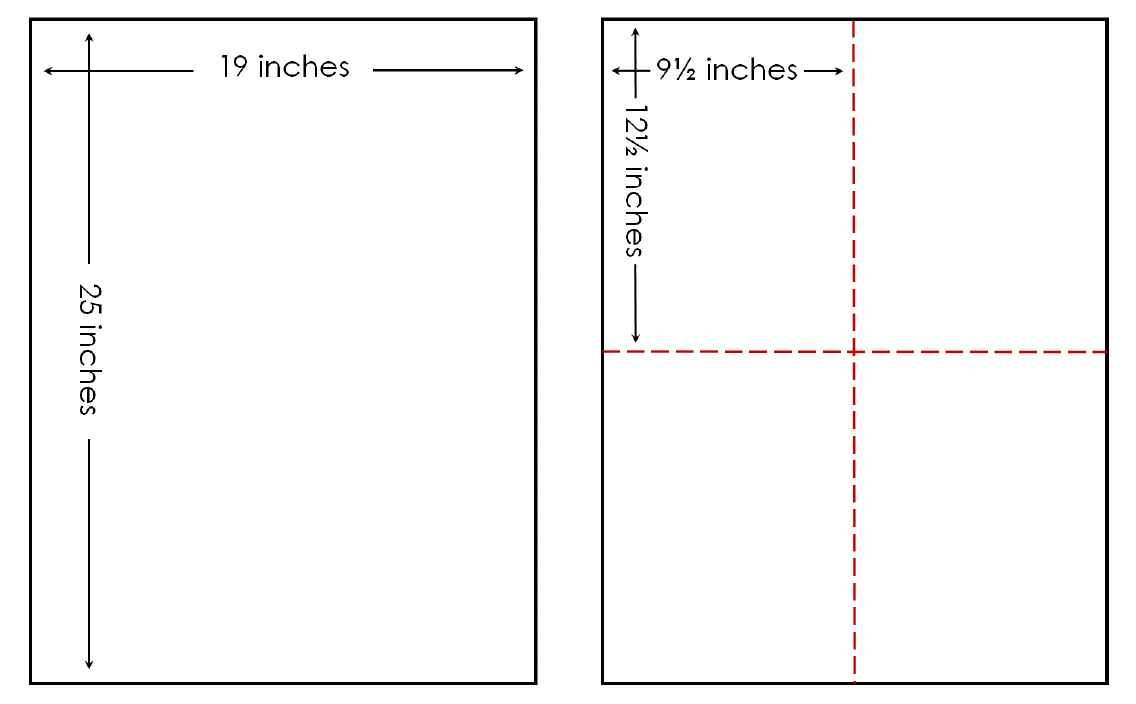
Texoprint is a very durable, waterproof paper that works very well for marbling. It is a commercial printing paper and is never available in art supply or stationery stores. It was designed to be a paper that can get wet and not fall apart, and so is used for such diverse purposes as menus, nautical maps, outdoor posters, and frozen food labels. It also doesn’t shrink, wrinkle, or buckle up when it dries. It contains a bit of latex in with the fiber, which gives it its waterproof qualities. With Texoprint you will never have to worry about the corners ripping off when you pick up a wet sheet, as so many other papers do, or about having to press it flat for weeks to remove the creases caused by your drying rack. Bookbinders may need to know this: the grain runs longways, from top to bottom, on both the 9½"x12½" sheets and the 19"x25" sheets. It is also excellent for making paste papers.
This paper is made in giant rolls in a small factory beside Lake Superior, on the north shore of the Upper Peninsula of Michigan. It is not a regular production item; the only time they make it is if some big corporation requests a few million sheets, then they fire up the mill and produce a run of it. It then gets sent to Wisconsin to be cut into sheets. So whenever they make some, once every year or two, they run off an extra roll of it for us (if they remember to), and I drive there to get a truck full (which weighs my poor pickup to the ground, and makes the braking ability rather scary). The main purpose of the paper is for industrial use; we are one of only three places in the country where it is sold for individual use -- and the other two places buy it from us. Because of its rarity, we don't offer volume discounts -- there is always the possibility we might run out totally before they produce any more.
But since the perfect marbling paper has yet to be invented, it still has a few characteristics that have to be worked around. It is not as absorbent as some papers, so you may have to use a slightly stronger alum solution than you are used to — we recommend about 1/3 cup alum to 1 gallon water (or 1 teaspoon to one cup water). After applying the alum, let the papers dry completely, then stack them and press them under a heavy board for several hours or overnight, before marbling. The flatter the better; any curled-up corners will affect the pattern, or trap air bubbles. Texoprint tends to lose its alum if exposed for long to the air (though other brands of paper can also do this). If alum-coated papers are left exposed for more than two days, the alum will start to oxidize and disappear from the sheet, so of course the paints won’t stick. Even if the papers are stacked, this will happen all around the edges if they are exposed for long. To avoid this, they should be used within a day or two after being alum-treated. If not, the treated papers can be kept inside a large plastic bag where they won’t be exposed to the air. When kept in a bag, the sheets will be good for weeks.
Because this paper is not as absorbent as you may be used to, small layout glitches can be a problem until you get the hang of the proper layout, especially around the edges. These are small areas where the pattern looks somewhat warped, and are more noticeable with combed patterns than stone patterns. Rather than lowering the paper until the center of it touches the size, you must hold opposite corners and lower just one of the other two free corners until it is on the size, and then gradually lower the rest of the paper. In other words, when printing, one corner of the paper should touch the size first, rather than the center of the sheet.
The sheets of paper may be shipped to you in a roll, instead of flat. This should be no problem to you -- just unroll it, lay a book or a board on the stack, and it will flatten out very nicely. The sheets will also flatten as soon as they get wet with the alum solution. We have to cut the 9½ x 12½" sheets ourselves here out of the larger sheets, on a chop-arm cutting board; so they may not be perfectly sized -- perhaps a millimeter or two off, one way or the other.